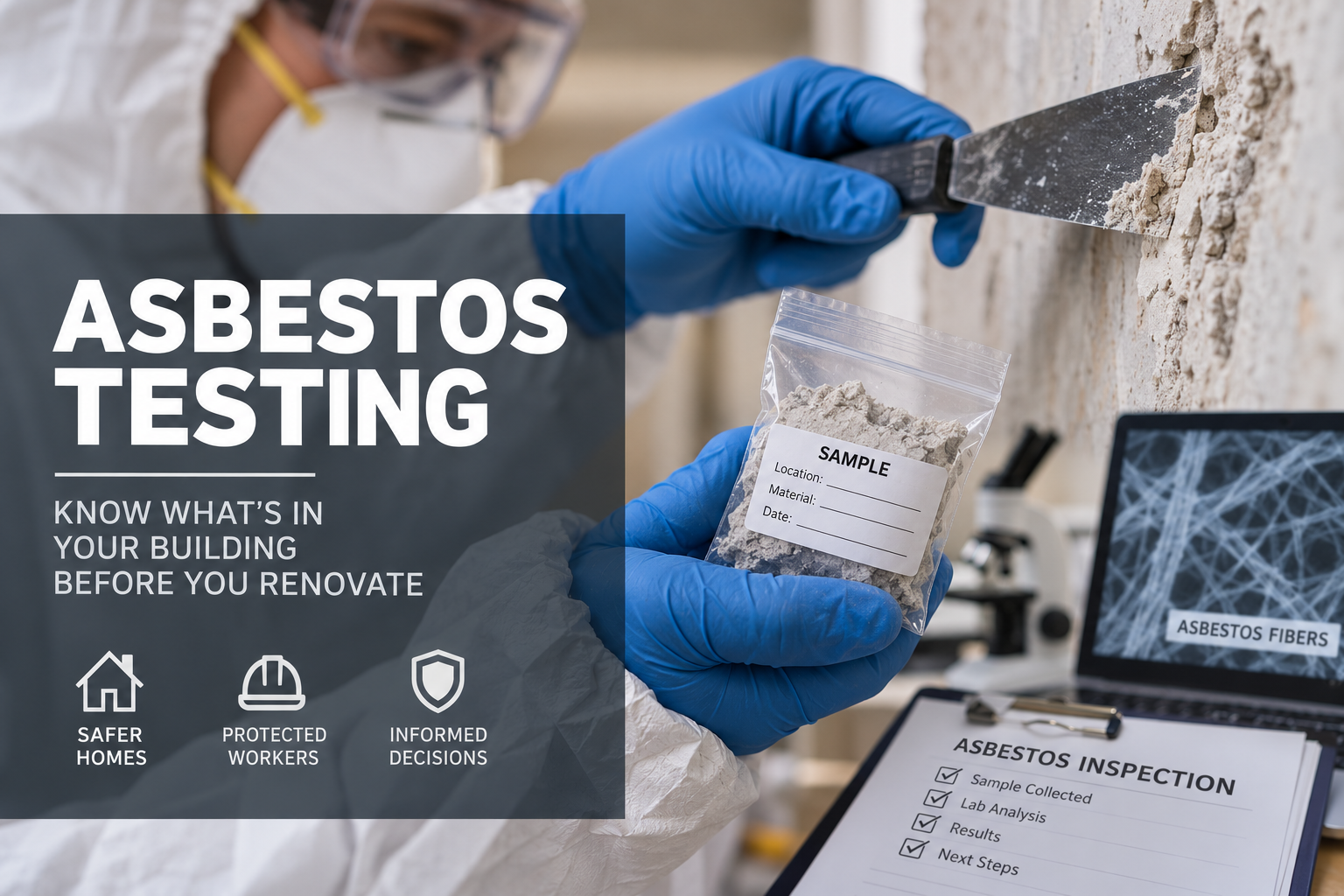
asbestos testing
Asbestos Testing: A Complete Guide for Homeowners, Property Owners and Workers
Asbestos testing is one of the most important steps to consider before renovating, demolishing, repairing, or significantly disturbing materials in an older building. Asbestos was historically used in many construction products because of its resistance to heat, fire, and deterioration. The problem is that asbestos fibers can become hazardous when asbestos-containing materials are damaged or disturbed and fibers become airborne.
For homeowners, property buyers, landlords, contractors, workers, and building managers, the difficulty is simple:
you usually cannot determine whether a material contains asbestos just by looking at it.
A ceiling tile may look harmless. Old flooring may appear perfectly ordinary. Pipe insulation, textured coatings, roofing products, cement materials, drywall compounds, and other building products may look similar whether they contain asbestos or not.
That is why professional asbestos testing can be important.
An asbestos test can help determine whether a suspicious building material contains asbestos before work begins. Depending on the situation, testing may involve an inspection of the property, professional collection of samples, laboratory analysis, and sometimes air monitoring.
This guide explains what asbestos testing is, when it may be needed, which materials may require attention, what happens during professional testing, how laboratory results are interpreted, and what property owners should consider after receiving a positive asbestos test.
What Is Asbestos Testing?
Asbestos testing is the process of evaluating a material or environment to determine whether asbestos fibers are present.
The most common form of asbestos testing involves collecting a small sample of a suspected building material and sending it to a qualified laboratory for analysis.
Testing may be performed on materials such as:
- Floor tiles
- Vinyl flooring
- Flooring adhesive or mastic
- Ceiling tiles
- Textured ceilings
- Wall coatings
- Plaster
- Drywall compounds
- Pipe insulation
- Boiler insulation
- Heating-system insulation
- Roofing materials
- Siding
- Cement products
- Insulation materials
- Fireproofing materials
The purpose of the test is not simply to identify an old material. It is to determine whether asbestos is actually present.
That distinction matters because age, appearance, color, texture, or location alone cannot reliably confirm asbestos.
Why Asbestos Testing Matters
Many property owners first think about asbestos after discovering suspicious material during a renovation.
A contractor may remove a section of flooring and discover another layer underneath. A homeowner may open a wall and find old insulation. A building manager may notice deteriorating pipe insulation. A buyer may discover an older textured ceiling during an inspection.
At that point, continuing the work without understanding what the material contains can create unnecessary risk.
Disturbing asbestos-containing material can potentially release microscopic fibers into the surrounding air.
Activities that may disturb building materials include:
- Cutting
- Drilling
- Sanding
- Breaking
- Grinding
- Demolition
- Removing flooring
- Removing insulation
- Opening walls
- Scraping textured surfaces
- Major remodeling work
Professional asbestos testing can provide information before these activities continue.
Can You Tell If Something Is Asbestos by Looking at It?
Usually, no.
This is one of the most common misunderstandings about asbestos.
People sometimes assume that asbestos has a specific color, texture, or appearance. In reality, asbestos was incorporated into many different products.
Two pieces of flooring manufactured during the same era may look almost identical while only one contains asbestos.
The same problem applies to insulation, ceiling materials, roofing, siding, plaster, adhesives, and other products.
A building material’s appearance can sometimes raise suspicion, but appearance alone cannot reliably establish whether asbestos is present.
Laboratory analysis is generally needed for confirmation.
When Should You Consider Asbestos Testing?
Not every older home automatically needs to be tested from top to bottom.
Testing becomes particularly relevant when suspicious building materials may be disturbed.
Before Renovating an Older Property
Renovation is one of the most common reasons homeowners search for asbestos testing.
Projects involving walls, ceilings, floors, heating systems, insulation, or other older building materials may disturb materials that have remained untouched for decades.
Testing before work begins can help identify materials requiring special handling.
Before Demolition
Demolition creates much more disturbance than normal property use.
Walls are broken apart, ceilings are removed, flooring is lifted, mechanical systems are dismantled, and large quantities of construction material can become debris.
Because of the potential for disturbance, asbestos evaluation before demolition may be required depending on the property, project, and jurisdiction.
Property owners and contractors should understand applicable local and workplace requirements before demolition begins.
Before Removing Old Flooring
Old flooring is another common reason for asbestos testing.
Potential areas of concern can include:
- Vinyl floor tiles
- Sheet flooring
- Flooring backing
- Adhesive
- Black flooring mastic
- Underlayment
It is important not to assume that a floor is safe simply because the visible top layer is newer.
Homes are frequently renovated by installing new flooring directly over old flooring. Several generations of flooring can therefore exist in the same room.
Before Disturbing Old Pipe or Boiler Insulation
Older heating systems sometimes contain insulation materials that may require evaluation.
Potential locations include:
- Boiler rooms
- Basements
- Mechanical rooms
- Heating pipes
- Steam pipes
- Furnace areas
- Duct systems
Damaged or deteriorating insulation deserves particular caution.
Instead of touching or removing suspicious insulation to investigate it, a qualified asbestos professional can evaluate the area.
When Building Materials Are Damaged
Material that remains intact and undisturbed may present a very different situation from material that is breaking apart.
Warning signs can include:
- Crumbling
- Fraying
- Water damage
- Broken surfaces
- Loose material
- Deteriorated insulation
- Damaged ceiling coatings
- Construction debris
If potentially asbestos-containing material is deteriorating, professional evaluation may be appropriate.
Common Materials That May Be Tested for Asbestos
Asbestos was incorporated into a wide range of building products.
The presence of one of these products does not automatically mean asbestos is present. Instead, these are examples of materials that may warrant investigation depending on their age and circumstances.
Floor Tiles
Flooring is one of the most recognizable categories associated with asbestos testing.
Older vinyl tiles and associated materials may sometimes contain asbestos.
The adhesive beneath the floor may also require separate consideration.
A renovation project therefore may involve more than simply testing the visible tile.
Flooring Adhesive and Mastic
Old adhesives can remain attached to subfloors long after the original flooring has been replaced.
Dark-colored adhesive is sometimes associated with older flooring installations, but color alone cannot determine whether asbestos is present.
Laboratory analysis is required for reliable identification.
Popcorn and Textured Ceilings
Textured ceilings are frequently searched in connection with asbestos.
Terms such as:
- asbestos popcorn ceiling
- asbestos ceiling test
- asbestos ceiling testing
- textured ceiling asbestos
remain common because many homeowners encounter older ceiling finishes during remodeling.
A textured ceiling should not automatically be considered asbestos-containing. However, if it is older and will be disturbed, professional evaluation may be appropriate.
Ceiling Tiles
Older ceiling tiles may contain a variety of fibers and materials.
They may appear in:
- Homes
- Offices
- Schools
- Warehouses
- Commercial buildings
- Basements
Because visual appearance cannot provide certainty, suspicious ceiling materials may require laboratory analysis.
Pipe Insulation
Pipe insulation is another material historically associated with asbestos.
It can appear as wrapping, molded insulation, or other thermal insulation systems.
Older mechanical areas should be approached carefully, particularly when insulation is damaged.
Wall and Ceiling Plaster
Older plaster systems may contain multiple layers and materials.
The visible plaster surface may not be the only material requiring consideration.
Depending on the construction system, an inspector may evaluate different components separately.
Drywall Joint Compound
Drywall itself is often only one part of a wall system.
Joint compound, patching materials, textured coatings, and other products applied around drywall may be different materials produced by different manufacturers.
Professional inspectors consider these distinctions when planning an asbestos survey.
Roofing Materials
Some older roofing materials may contain asbestos.
Examples can include certain:
- Roofing shingles
- Roofing felts
- Mastics
- Cement products
- Flashing compounds
Roof replacement and demolition projects can therefore require additional investigation.
Siding
Certain older exterior siding products may contain asbestos, particularly some cement-based products.
Because these materials can remain durable for many decades, asbestos-containing siding may still exist on older buildings.
Cement Products
Asbestos fibers were historically added to some cement products to improve durability and heat resistance.
These products can be very different from soft or fluffy insulation normally associated with asbestos.
This is another reason visual identification is unreliable.
How Professional Asbestos Testing Works
A professional asbestos test generally involves several stages.
The exact procedure depends on the property, materials involved, local regulations, and purpose of the investigation.
1. Property Evaluation
The process often begins with an inspection.
The inspector may review:
- Building age
- Renovation history
- Areas scheduled for demolition
- Types of building materials
- Condition of suspicious materials
- Locations where contractors will work
The objective is to determine which materials may need further evaluation.
2. Identification of Suspect Materials
Different materials are usually considered separately.
For example, a wall assembly might contain:
- Drywall
- Joint compound
- Plaster
- Paint or texture
- Adhesive
An experienced inspector considers how the building was constructed rather than treating every surface as a single material.
3. Professional Sample Collection
When sampling is appropriate, a trained professional collects material for analysis.
Professional collection is important because unnecessarily disturbing suspected asbestos-containing materials may release fibers.
For this reason, homeowners should generally avoid cutting, scraping, sanding, or breaking suspicious materials simply to investigate them.
The safest approach is to have potentially hazardous material evaluated by someone trained to perform asbestos inspections and sampling.
4. Laboratory Analysis
Collected samples are sent to a qualified laboratory.
Laboratory specialists use microscopy and other analytical methods to determine whether asbestos fibers are present.
The laboratory report generally identifies the sample and records the analytical result.
5. Written Results
After analysis, the property owner typically receives documentation identifying:
- Sample locations
- Material descriptions
- Laboratory findings
- Whether asbestos was detected
- Additional observations when applicable
Keep these records.
They may become useful during future renovations, property transactions, contractor work, building management, insurance matters, or legal disputes.
What Laboratory Methods Are Used for Asbestos Testing?
Several analytical techniques may be used depending on the type of sample and reason for testing.
Polarized Light Microscopy
Polarized Light Microscopy, commonly abbreviated as
PLM, is widely used for analyzing bulk building materials.
It allows trained laboratory personnel to examine mineral fibers and identify asbestos based on specific optical characteristics.
PLM is commonly associated with testing materials such as insulation, plaster, ceiling material, flooring products, and other bulk construction samples.
Transmission Electron Microscopy
Transmission Electron Microscopy, or
TEM, provides much greater magnification and can identify extremely small fibers.
It may be used in circumstances where more detailed analysis is required.
The appropriate analytical method depends on factors including the material, applicable regulations, laboratory procedures, and purpose of the investigation.
Air Testing
Air testing is different from bulk material testing.
Bulk testing asks:
Does this building material contain asbestos?
Air testing asks:
Are asbestos fibers present in an air sample, and at what measured concentration under the applicable method?
Air monitoring may be used during certain asbestos-related projects, occupational investigations, or clearance procedures.
It should not automatically be considered a substitute for testing suspected building materials.
Asbestos Inspection vs. Asbestos Testing
People frequently use these terms interchangeably, but they can describe different parts of the process.
Asbestos Inspection
An asbestos inspection generally involves examining a building and identifying materials that may contain asbestos.
The inspector may document their:
- Location
- Type
- Condition
- Accessibility
- Potential for disturbance
Asbestos Testing
Asbestos testing usually refers more specifically to analyzing samples to determine whether asbestos is present.
A complete asbestos survey may combine inspection, sampling, laboratory analysis, and documentation.
Asbestos Testing Before Renovation
If you are planning an older-home renovation, testing may prevent major complications later.
Imagine beginning a kitchen renovation and discovering unexpected flooring beneath the cabinets.
Or opening a basement ceiling and finding old pipe insulation.
Or removing drywall and discovering an older layer of plaster.
Stopping halfway through the project can lead to:
- Construction delays
- Additional contractor expenses
- Disposal issues
- Scheduling problems
- Unexpected inspections
- Possible contamination concerns
Identifying suspicious materials before construction begins allows property owners to plan more effectively.
Asbestos Testing Before Buying a Home
Homebuyers frequently ask whether asbestos testing should be part of a property purchase.
The answer depends on the building, its condition, planned renovations, and information available from the seller or inspection.
An older home does not automatically mean that every material contains asbestos.
However, buyers planning major renovations may want more information about suspicious materials before construction starts.
Potential areas to examine can include:
- Basement pipe insulation
- Old flooring
- Textured ceilings
- Heating equipment
- Exterior siding
- Attic materials
- Older wall systems
An ordinary home inspection and a specialized asbestos inspection are not necessarily the same service.
Buyers who specifically want asbestos evaluation should confirm what is included in the inspection they order.
Asbestos Testing for Commercial Buildings
Asbestos testing is not limited to residential homes.
Commercial and institutional buildings can contain a much wider range of construction materials.
Examples include:
- Offices
- Factories
- Warehouses
- Apartment buildings
- Schools
- Government buildings
- Retail properties
- Hotels
- Hospitals
- Industrial facilities
Commercial properties may also be subject to workplace safety requirements that do not apply in the same way to ordinary homeowners.
Building owners, employers, contractors, and property managers should understand the rules that apply to their specific projects.
What Does a Positive Asbestos Test Mean?
Receiving a laboratory result showing asbestos can be alarming.
However, a positive test does not automatically mean that the entire building must be demolished or that every asbestos-containing material must immediately be removed.
The appropriate response depends on several factors.
These include:
- Condition of the material
- Location
- Whether it will be disturbed
- Type of project planned
- Accessibility
- Applicable laws and regulations
- Recommendations from qualified professionals
Material that is intact and unlikely to be disturbed may be handled differently from severely damaged material located in an active renovation area.
A qualified asbestos professional can help determine the appropriate next step.
Does Asbestos Always Need to Be Removed?
Not necessarily.
Removal is only one form of asbestos management.
Depending on the situation, professional recommendations may involve:
- Leaving intact material undisturbed
- Monitoring its condition
- Encapsulation
- Enclosure
- Repair
- Controlled removal
The appropriate solution depends on the building material and circumstances.
Property owners should avoid assuming that the most aggressive option is automatically the safest or most appropriate one.
What Should You Do While Waiting for Asbestos Test Results?
If suspicious material has already been discovered, avoid unnecessarily disturbing it while waiting for professional evaluation.
Do not continue cutting, drilling, sanding, breaking, or removing the material simply to determine what it is.
A cautious approach can prevent additional disturbance until the results are known.
If construction work is already underway, contractors and building managers should follow applicable safety requirements and professional guidance.
How Long Does Asbestos Testing Take?
Testing time depends on several factors:
- Number of samples
- Laboratory workload
- Type of analysis
- Location
- Requested turnaround time
- Complexity of the materials
Some laboratories offer different turnaround options.
The complete process may also include scheduling an inspection, collecting samples, delivering them to the laboratory, performing the analysis, and preparing a written report.
Property owners planning renovations should account for asbestos evaluation early rather than waiting until construction is scheduled to begin.
How Much Does Asbestos Testing Cost?
There is no single asbestos testing price that applies to every property.
The total cost can depend on:
- Number of materials tested
- Number of samples required
- Size of the property
- Location of suspect materials
- Type of building
- Laboratory method
- Inspection requirements
- Turnaround time
- Whether air testing is needed
- Local professional rates
A small investigation involving one suspicious material can be very different from a full asbestos survey of a large commercial property.
When comparing asbestos testing companies, ask what the quoted price includes.
For example, determine whether the price covers:
- Inspection
- Sample collection
- Laboratory fees
- Travel
- Written report
- Additional samples
- Expedited results
Comparing complete services is more useful than comparing one advertised number.
How to Choose an Asbestos Testing Company
Selecting a qualified asbestos professional is an important part of obtaining useful results.
Consider asking the following questions.
Are You Trained or Licensed for Asbestos Inspection?
Requirements vary by jurisdiction.
Confirm what credentials apply where the property is located.
Which Laboratory Will Analyze the Samples?
Ask whether the laboratory has appropriate qualifications or accreditation for asbestos analysis.
Will I Receive a Written Laboratory Report?
Documentation matters.
Avoid relying only on an informal verbal statement that a material is “probably safe.”
How Are Sample Locations Documented?
Clear sample identification helps connect laboratory results to the correct building materials.
Do You Also Perform Asbestos Removal?
Some companies provide inspection and removal services, while others specialize only in testing.
Understanding the company’s role can help you evaluate the recommendations you receive.
DIY Asbestos Testing vs. Professional Testing
Home asbestos test kits are sometimes marketed to consumers, but there is an important distinction between laboratory analysis and safe sample collection.
The laboratory may be able to analyze a submitted material correctly.
The problem is obtaining the sample.
Sampling suspicious material involves intentionally disturbing it.
If done incorrectly, that disturbance may release fibers.
For that reason, professional sampling is generally the safer approach, especially when dealing with deteriorated materials, insulation, large areas, renovation sites, or unfamiliar building products.
Testing should provide information without creating unnecessary exposure.
Can You Test the Air for Asbestos?
Yes, air samples can be analyzed for asbestos fibers in certain circumstances.
However, homeowners sometimes misunderstand what an air test means.
An air test does not necessarily tell you whether a particular floor tile, ceiling coating, wall material, or insulation product contains asbestos.
Bulk material testing and air testing answer different questions.
Air monitoring may be useful during specialized asbestos projects, occupational evaluations, or post-abatement procedures.
A professional can determine which type of testing fits the situation.
Asbestos Testing After Renovation or Demolition
Testing after work has begun can be more complicated than testing beforehand.
If suspicious material was already disturbed, the situation may require more than simply analyzing the original material.
Depending on the circumstances, professionals may evaluate:
- Remaining building materials
- Dust
- Debris
- Work areas
- Adjacent areas
- Air conditions
- Cleanup needs
This is another reason asbestos testing before renovation can be valuable.
Pre-project testing can reduce uncertainty before demolition begins.
What Happens If Workers Discover Suspected Asbestos?
Construction workers are often the first people to uncover unexpected materials.
A worker may remove a ceiling, wall, pipe covering, floor, or mechanical component and discover something that was not visible during the original inspection.
When suspicious material is discovered, continuing to disturb it without proper evaluation can make the situation worse.
Employers and contractors may have specific responsibilities under workplace safety laws.
Documentation, professional assessment, and compliance with applicable regulations become especially important in occupational settings.
Asbestos Testing and Property Records
Keep copies of asbestos inspection reports and laboratory results.
Future owners, tenants, contractors, maintenance workers, and property managers may need this information.
Useful documentation can include:
- Inspection date
- Inspector information
- Sample numbers
- Sample locations
- Material descriptions
- Laboratory results
- Abatement records
- Clearance documentation
- Contractor records
Accurate records can prevent the same materials from being repeatedly investigated and can help future workers understand known asbestos locations.
Asbestos Testing and Legal Claims
Asbestos disputes can involve complicated questions about exposure, property conditions, workplace practices, product history, and responsibility.
Testing records can sometimes become important evidence because they may help establish what materials were present in a particular location.
Documents that may become relevant can include:
- Laboratory reports
- Building inspection records
- Renovation records
- Employment records
- Contractor documents
- Property maintenance files
- Asbestos surveys
- Abatement reports
- Workplace safety documentation
However, a positive asbestos test by itself does not establish that a particular person was exposed, that an illness resulted from that exposure, or that another party is legally responsible.
Those questions depend on the facts of the individual situation and applicable law.
Asbestos Testing and Mesothelioma or Asbestos Exposure Cases
People researching asbestos testing sometimes do so because they are concerned about past asbestos exposure rather than a current renovation.
Exposure investigations can involve locations such as:
- Construction sites
- Shipyards
- Factories
- Industrial facilities
- Power plants
- Schools
- Commercial buildings
- Residential properties
- Mechanical rooms
- Older renovation sites
Historical exposure cases are often more complicated than testing a material that is still present today.
The original products may have been removed decades earlier.
Investigations may therefore depend on several types of information, including employment history, property records, product information, witness accounts, contractor records, and historical documentation.
Anyone dealing with a health concern should speak with an appropriate healthcare professional. Questions about legal rights or claims should be discussed with a qualified attorney in the relevant jurisdiction.
Frequently Asked Questions About Asbestos Testing
What is the most accurate way to know whether a material contains asbestos?
Laboratory analysis of an appropriately collected sample is generally necessary to confirm whether a suspicious building material contains asbestos.
Visual inspection alone cannot reliably provide confirmation.
Can asbestos be identified by color?
No.
Asbestos-containing materials come in many colors and appearances.
Color is not a reliable asbestos test.
Should I test my entire house for asbestos?
Not necessarily.
Testing is particularly relevant when suspicious materials are damaged or are likely to be disturbed during renovation, demolition, repair, or maintenance.
A professional asbestos inspector can help determine the appropriate scope.
Should I test before remodeling?
If the renovation will disturb suspicious older materials, asbestos evaluation before construction may be appropriate and may also be required under certain regulations.
Testing early can help prevent unexpected delays.
Can a regular home inspector test for asbestos?
Some home inspectors may have additional asbestos qualifications, while others do not.
Ask specifically whether asbestos inspection and laboratory testing are included.
Is asbestos testing the same as asbestos removal?
No.
Testing identifies whether asbestos is present.
Removal is an asbestos abatement activity that occurs after asbestos has been identified and a management decision has been made.
Can asbestos remain in a building safely?
In some circumstances, asbestos-containing material that is intact, protected, and unlikely to be disturbed may be managed in place.
The appropriate approach should be determined based on the condition of the material, future building work, and applicable requirements.
Do newer homes contain asbestos?
Building age can help determine the likelihood of encountering older asbestos-containing products, but age alone should not be treated as a laboratory result.
Manufacturing history and regulations vary by product and jurisdiction.
When there is a legitimate reason to suspect asbestos, qualified professional evaluation is more reliable than assumptions based solely on construction date.
Is asbestos air testing enough?
Not always.
Air testing and material testing answer different questions.
If the goal is to determine whether a specific building material contains asbestos, bulk material analysis may be necessary.
Can asbestos testing damage my house?
Professional sampling generally removes only the amount of material necessary for analysis.
The sampling professional should select appropriate locations and manage the area according to applicable procedures.
Do I need asbestos testing before selling a house?
Requirements differ by jurisdiction and property.
Sellers and buyers should understand local disclosure rules, property conditions, planned renovations, and any known asbestos records.
What happens when asbestos is found?
The next step depends on the material’s condition and whether it will be disturbed.
Professional recommendations may include leaving it undisturbed, managing it in place, encapsulating it, enclosing it, repairing it, or removing it.
Why Testing Before Disturbance Is So Important
The ideal time to investigate suspicious building material is usually before major disturbance occurs.
A property owner who discovers an old floor before renovation can evaluate it.
A contractor who finds suspicious pipe insulation before demolition can stop and obtain professional guidance.
A building manager preparing a renovation can review existing asbestos documentation before workers enter the area.
Planning reduces uncertainty.
Once suspicious materials have already been broken, sanded, demolished, or scattered through a work area, the situation can become more complicated.
Final Thoughts on Asbestos Testing
Asbestos testing provides something extremely valuable to homeowners, contractors, workers, landlords, property managers, and buyers: information.
Without testing, people may rely on guesses based on a building’s age or the appearance of a material.
Those guesses can be wrong.
Professional asbestos testing can help determine whether suspicious building materials actually contain asbestos and provide documentation that can guide renovation, demolition, maintenance, property management, and other decisions.
The most important principle is simple:
Do not unnecessarily disturb suspicious material simply to find out what it is.
When an older material is damaged or will be affected by renovation or demolition, having it evaluated by a qualified asbestos professional can help determine the appropriate next step.
Testing is not the same as removal, and a positive result does not automatically mean an entire building is dangerous or must be demolished.
It means you have better information.
From there, qualified professionals can help determine how the material should be managed based on its condition, location, planned work, and applicable regulations.
For property owners, that knowledge can prevent unexpected renovation problems.
For workers and contractors, it can support safer project planning.
And when asbestos exposure becomes part of a legal dispute, properly documented testing, inspection, employment, construction, and property records may become important pieces of a much larger investigation.